- (407) 774-8324
- JDMFlorida@gmail.com
 Login
Login


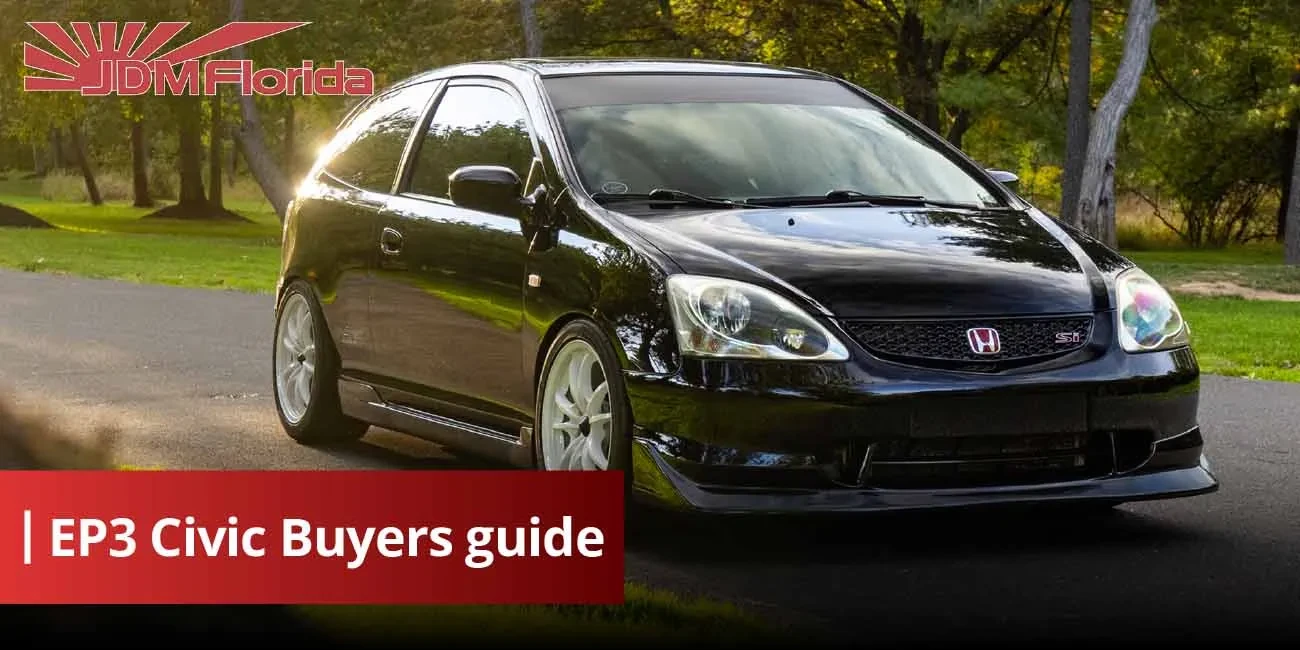
EP3 Civic Buyer's Guide: Honda Civic Type R, K20A Engine & 6-Speed Transmission
The EP3 Civic is one of the most iconic JDM hot hatches ever made. Two decades on, demand for the Honda Civic EP3, the K20A engine, and the 6-speed manual transmission has not slowed down. Whether you are buying a clean chassis, replacing a worn-out motor, or swapping in a Type R gearbox, this guide covers everything you need to know.
What Is the EP3 Civic?
The EP3 is the seventh-generation Honda Civic hatchback. Honda built it from 2001 to 2005. It was sold as a regular hatch and, more importantly, as the Civic Type R.
Honda Civic Type R (EP3) Chassis History
Honda launched the EP3 Type R in 2001 as the successor to the EK9 Type R. It used a stiffer chassis, a larger cabin, and a more powerful K-series engine. The Type R badge brought a limited-slip differential, Recaro seats, and a tuned suspension setup straight from the factory.
JDM vs UKDM vs USDM Versions
The EP3 came in three main regional specs:
JDM: K20A engine, 6-speed manual, full Type R package
UKDM: Very close to JDM, K20A2 engine, also sold as Type R
USDM: K20A3 engine, 5-speed manual, sold as Civic Si, not a true Type R
Production Years: 2001 to 2005
Honda produced the EP3 for four model years. The chassis stayed largely the same throughout. Minor updates touched the front fascia and interior trim over the years.
EP3 Civic Type R K20A Engine
The K20A is the heart of the JDM EP3. It is a 2.0-liter DOHC inline-four with Honda's i-VTEC system. If you need a replacement, browse our K20A engine for sale listings.
K20A Specs (2.0L DOHC i-VTEC)
Displacement: 1998cc
Compression ratio: 11.0:1
Redline: 8,400 rpm
Variable valve timing on both intake and exhaust (i-VTEC)
Stock Horsepower and Torque
The JDM K20A produces 215 hp and 149 lb-ft of torque in Type R tune. That is a significant step above the USDM K20A3, which makes 160 hp.
PRB Head, What Makes It Special
The Type R K20A uses a PRB cylinder head. It has larger ports, more aggressive cam profiles, and better flow than other K20 heads. The PRB head is the most sought-after K20 head for both OEM rebuilds and performance builds.
Common K20A Engine Issues
Oil consumption: Piston rings wear on higher-mileage engines
VTEC solenoid: Can clog with old oil, causing solenoid noise or codes
Timing chain tensioner: Rattles on cold starts when worn
Valve train noise: Often just a sign of overdue valve adjustments
EP3 Civic 6-Speed Transmission
The gearbox is one of the key differences between the JDM and USDM cars. Source a replacement using our EP3 transmission page.
EP3 5-Speed (USDM) vs 6-Speed (JDM Type R)
The USDM Civic Si uses a 5-speed manual. The JDM Type R gets a close-ratio 6-speed. The 6-speed has shorter gear spacing and handles the K20A's high-rpm power much better. It also runs a helical LSD as standard.
Code Identification
Y80: JDM Type R 6-speed, no LSD
M2S4: JDM Type R 6-speed with LSD
ASP3: UKDM Type R variant
NRH3: Used on some JDM Si models
LSD Differences
The M2S4 is the one to find. It includes a factory helical limited-slip differential. This improves traction out of corners and makes the car much more fun to drive quickly. The Y80 is a capable gearbox but misses the LSD.
Transmission Swap Compatibility
The EP3 6-speed swaps directly into the EK and DC2 chassis with the right axles and shift linkage. It also bolts to any K-series engine. This makes it a popular upgrade for K-swapped Civics and Integras.
JDM vs USDM EP3 — Key Differences
This is the most important section if you are sourcing parts or planning a swap. Check our full range of JDM Honda engines for both specs.
Engine: K20A (JDM) vs K20A3 (USDM)
The K20A makes 215 hp in JDM tune. The K20A3 makes 160 hp. The difference comes down to the head, cams, and ECU calibration. The K20A3 uses a SOHC-style head without full i-VTEC.
Transmission: 6MT (JDM) vs 5MT (USDM Si)
As covered above, the JDM car gets a 6-speed with LSD. The USDM Si gets a 5-speed with an open differential. This is one of the most common upgrades USDM owners do.
Interior: Recaro Seats, Momo Wheel, Gauge Cluster
JDM Type R cars came with factory Recaro bucket seats, a Momo steering wheel, and a gauge cluster with a red Type R logo. These interior pieces are popular finds at JDM importers and salvage yards.
Bodywork: Front Bumper, Hood, Fenders
The JDM Type R front bumper has larger air intakes and a different lower valance. The hood has a functional scoop on some editions. Fenders are slightly flared to cover a wider track. USDM fenders and bumpers will not match JDM body kits directly.
EP3 Civic Common Issues & Maintenance
The EP3 is a reliable car when maintained properly. Here are the issues to watch for:
VTEC Solenoid Noise
A clogged VTEC solenoid will make a ticking noise or throw a fault code. Replace the solenoid screen and change the oil regularly. This fix is cheap and easy.
Oil Burn and Piston Ring Wear
High-mileage K20A engines can burn oil. Check the dipstick before buying any used EP3. Light oil burning is manageable. Heavy consumption often means a rebuild is due.
Suspension Wear: Front Bushings
The front control arm bushings wear out over time. You will feel it as vague steering and mild chassis flex. Polyurethane replacement bushings are affordable and restore the sharp handling the EP3 is known for.
Timing Chain Wear
The K20A uses a timing chain, not a belt. Chains last longer, but they do wear. A rattling noise on a cold start is the first sign. Replacing the tensioner and guides usually fixes it before a full chain replacement is needed.
Pre-Purchase Inspection: What to Check Before You Buy
Buying a used EP3, especially an imported JDM example, requires a thorough inspection checklist that goes beyond the usual used-car walkthrough.
Start under the hood: check for oil sludge around the valve cover and cam journals, which point to neglected oil changes, the fastest way to kill a K20A. Pull the dipstick and look for a milky or frothy residue, which signals a head gasket issue. With the engine running, listen carefully at idle for timing chain rattle, VTEC solenoid ticking, or any knocking from the bottom end.
Next, move to the chassis. The EP3's front subframe mounting points and rear beam are prone to surface rust on older imports, and structural rust in these areas is expensive to address correctly. Inspect the inner arches and sill sections with a torch.
Check the condition of the front lower control arm bushings by rocking the wheel at the 9- and 3-o'clock positions; any play indicates worn bushings or ball joints. Inside the cabin, test the Recaro seat runners if the car is a JDM Type R, as the sliders corrode and seize over time.
According to a detailed used car inspection guide by Edmunds, checking service records and conducting a pre-purchase inspection with a trusted mechanic can save thousands in unexpected repair costs, advice that applies doubly to a high-strung JDM performance car like the EP3.
Always request a vehicle history report or Japanese auction sheet where available, as a clean record on a JDM EP3 is worth more than any seller's verbal assurance.
EP3 Civic Engine Swap Options
Many EP3 owners upgrade the engine. Here are the most popular routes. For a full comparison, read our K20 vs K24 swap guide.
K20A Type R (PRB Head): The OEM-Spec Upgrade
If your K20A is tired, the cleanest swap is another JDM K20A Type R with a PRB head. Everything bolts up exactly. You get OEM reliability with full Type R power. Check our Civic Type R engines for available units.
K24A Swap: Torque-Monster Build
The K24A is a 2.4-liter K-series engine. It makes more torque than the K20A and pulls hard from low rpm. It fits the EP3 bay with minimal modifications. This swap suits street driving more than track use.
K24A2 + K20A Head: The K24/K20 Frankenswap
This is the most popular performance build for K-series Civics. You take a K24A2 block and mate it to a K20A Type R PRB head. The result is a 2.4-liter engine with the high-revving character of the K20A. Expect 230 to 260 hp in a naturally aspirated build.
Where to Find EP3 Civic Parts
Sourcing quality EP3 parts takes knowing where to look.
Body Parts and Trim
JDM front bumpers, hoods, and fenders are available through JDM importers. Check the condition carefully. Rust on inner panels is common on older imports. For trim pieces, Japanese Yahoo Auctions and direct importers are reliable sources.
Engine and Transmission Sources
For low-mileage engines and gearboxes, JDM importers are the best option. Japanese domestic engines typically have 40,000 to 60,000 miles at the time of import due to Japan's strict vehicle inspection laws. JDM Florida stocks K20A engines and EP3 transmissions ready to ship.
Interior Pieces: Recaro Seats and Type R Wheel
Original EP3 Type R Recaros and Momo wheels are sold through JDM dismantlers. Prices have risen as the car appreciates. Reproduction Momo wheels are available, but purists prefer the originals.
Is the EP3 Civic Worth Buying in 2026?
Market Values
Clean EP3 Type Rs have appreciated steadily. JDM imports in good condition now sell for $12,000 to $20,000, depending on mileage and originality. A decade ago, the same car was a $4,000 purchase. That trend is not reversing.
Appreciation Outlook
The EP3 is a genuine Type R. Supply is finite. As the enthusiast market for 2000s JDM cars grows, prices will keep climbing. Buying a good one now and maintaining it well is likely to hold value better than most modern performance cars in its price range.
Daily Ability
The EP3 is a practical daily driver. It has a usable back seat, decent fuel economy, and reliable mechanicals when maintained. The firm suspension can fatigue on rough roads, but it is nothing like a stripped track car. Most owners use them as weekend drivers with occasional track days.
Ready to Source Parts? Browse our K20A engines and EP3 transmissions at JDM Florida, low-mileage JDM units, shipped direct.
Here is a clear breakdown of both engines so you can pick the right one.
D17A1 vs D17A2 — Quick Comparison
D17A1 — Non-VTEC 1.7L
The D17A1 came in the base trim 2001–2005 Honda Civic LX and DX models.
It puts out around 115 horsepower and 110 lb-ft of torque. No VTEC means the power delivery is flat and predictable. The redline sits around 6,000 rpm.
It is a simple engine. It runs quietly, gets decent fuel economy, and holds up well with basic maintenance. Good for daily driving. Not exciting, but reliable.
D17A2 — VTEC 1.7L
The D17A2 came in the 2001–2005 Civic EX and HX. It uses a SOHC VTEC head, which is the main difference between these two engines.
It makes 127 horsepower and 114 lb-ft of torque. The redline stretches to around 6,500 rpm. When VTEC engages, the engine pulls harder in the upper rev range.
This is the engine Honda enthusiasts want. It costs more to use, but the power gain and higher redline make it worth it if you want more from your Civic. If you are looking for a D17A2 engine for sale, make sure it comes with a compression test result and clean oil.
D17A1 vs D17A2 Performance Differences
The D17A1 makes 115 hp. The D17A2 makes 127 hp. That is a 12 hp difference on paper.
In real life, it feels bigger than that. The D17A2 builds power more aggressively above 4,500 rpm. The D17A1 runs out of steam early. Both engines feel similar at low speeds, but the D17A2 stays alive higher in the rev range.
Torque is close. Both peak around the same rpm. But the D17A2 pulls cleaner through the mid-range, especially in third and fourth gear.
For a 2,600 lb Civic, the extra 12 hp is noticeable. Not fast by any standard, but more engaging.
Can You Swap a D17A2 into a D17A1 Car?
Yes. It fits. The D17A2 drops into any 2001–2005 Civic that had the D17A1.
But you need a few things to make it work right:
The D17A1 ECU will not control VTEC. You need a D17A2 ECU (P2E or P2T). You may also need to swap the wiring harness or add a VTEC solenoid wire if your car did not have one from the factory.
The intake manifold and exhaust manifold carry over. No axle changes needed. No mount changes either.
Difficulty level: moderate. If you have done a basic engine swap before, this is manageable. If not, budget for a few hours of shop time.
Estimated cost, including a used D17A2 engine, ECU, and basic hardware: around $1,200 to $2,000, depending on where you source parts.
Reliability & Common Issues
Both engines are reliable. Honda built them well. But both share a few known issues.
Oil burning is the most common complaint on high-mileage D17 engines. Check the valve seals and piston rings on any used unit. A compression test before purchase is not optional.
Valve adjustment matters more than people think. Both engines use mechanical valve lash. If the previous owner skipped this service, expect ticking and a rough idle.
D17A2-specific issue: The VTEC solenoid screen can clog over time. Dirty oil is usually the cause. Always use fresh oil in any D17A2 you buy, and clear the screen if the engine has been sitting. According to Honda-Tech community data, most D17 failures trace back to neglected maintenance rather than design flaws.
D17A1 vs D17A2 Price Differences
Used D17A1 engines typically sell for $400 to $700, depending on mileage.
D17A2 engines run higher, usually $700 to $1,100. The VTEC premium is real. Supply is also lower since EX and HX models were less common than the LX.
If you find a D17A2 priced like a D17A1, check it carefully. Low price often means high mileage, missing accessories, or unknown history.
Which D17 Should You Buy?
Choose the D17A1 if: You want a reliable, affordable replacement for a daily driver Civic. You do not plan to modify the car. Budget is tight.
Choose the D17A2 if: You want the VTEC engine, more rpm headroom, and a more engaging drive. You are willing to spend a bit more and match the ECU.
Skip both if: You are building a track car or want serious power. Neither D17 is a performance engine. At that point, look at a K20 vs. a K24 K-swap instead. The K-series is a completely different platform and will give you the power and tuning ceiling that a D17 never can.
For stock replacement or a mild upgrade, the D17A2 is the better buy. It is not a huge jump in power, but it is the right engine if you want the best version of the 1.7L.
Browse our full selection of JDM Honda engines and find a tested D17A2 engine for your Civic today. Every unit we carry comes inspected and ready to ship.