- (407) 774-8324
- JDMFlorida@gmail.com
 Login
Login


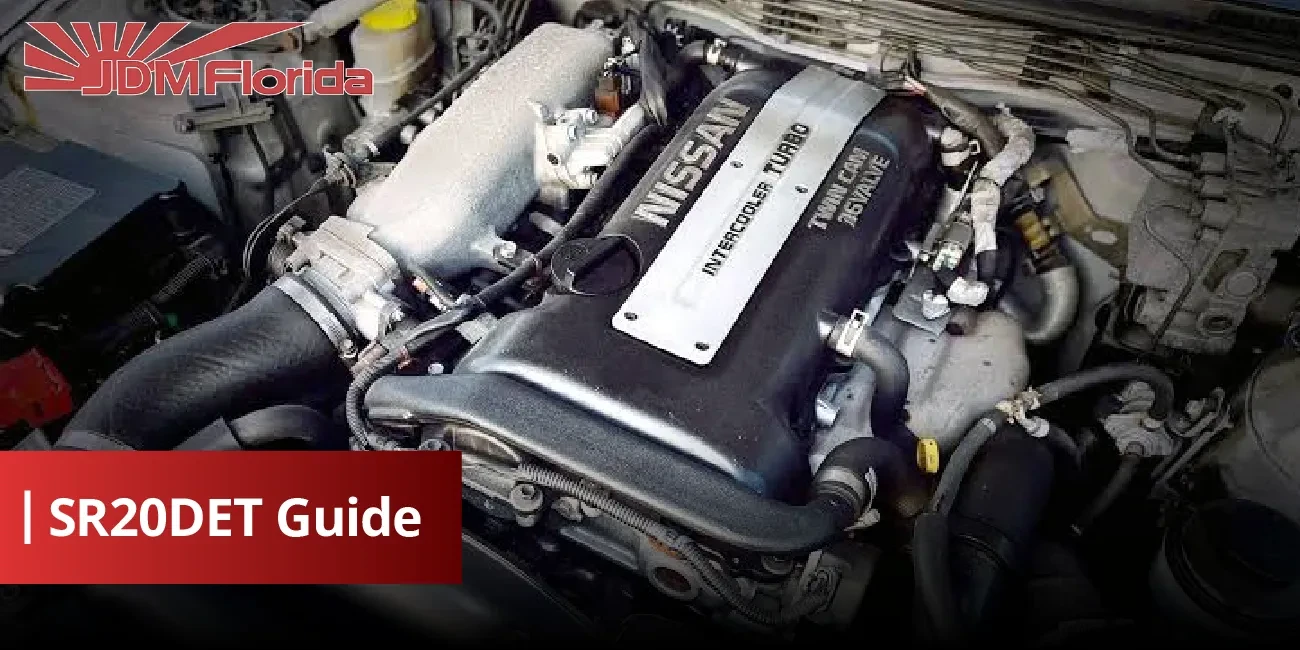
SR20DET Guide: Specs, Reliability & Swap Basics
The SR20DET is one of the most requested JDM engines on the market today. Drift builds, 240SX swaps, and Silvia restorations all lean on this engine because it's tough, tunable, and reasonably priced.
What is the SR20DET?
The SR20DET is a 2.0-liter turbocharged four-cylinder engine built by Nissan from 1989 to 2002. It sits in the SR family, which also includes the naturally aspirated SR20DE and SR20de engine variants used in cars like the Primera and Sentra SE R.
Nissan built the SR20DET as a replacement for the older CA18DET. It runs a DOHC 16-valve head, a cast iron block, and a single turbocharger. Most enthusiasts know it as the heart of the Nissan Silvia and 180SX lineup, though it also showed up in the Pulsar GTI R, the Bluebird, and a few other Nissan models most people never think about.
If you're shopping for a Nissan sr20det today, you'll mostly run into three generations. Each one has its own personality, and the differences matter more than people assume.
SR20DET specs and power
At its core, every SR20DET shares the same architecture. It's a 1998cc inline four with an 86mm bore and 86mm stroke, so it's what tuners call a square engine. The block is cast iron, and the head is aluminum, which keeps weight down while still holding up under boost.
Compression sits around 8.5 to 1 on most versions, though some variants drop slightly lower to handle more boost safely. The engine uses a timing chain rather than a belt, which means less scheduled maintenance over the life of the motor.
Redtop vs blacktop vs S15 variants
The valve cover color tells you which generation you're looking at, and it's the fastest way to identify a Nissan sr20det engine at a glance.
The Redtop came first, fitted to the early S13 Silvia and 180SX from 1991 to 1993. It ran a Garrett T25 turbo and made roughly 205 horsepower at the crank, though real-world figures often land lower once you factor in drivetrain loss.
The Blacktop followed in 1994 and stuck around through the S14 chassis. Nissan added VTC, or variable cam timing, along with a larger T28 turbo. Output climbed to around 217 to 220 horsepower depending on the exact model year.
The final version arrived with the S15 Silvia in 1999. This later blacktop paired a ball bearing T28R turbo with a six-speed gearbox, and it's generally regarded as the strongest factory tune, putting out close to 247 to 250 horsepower.
Keep in mind these numbers vary a bit between sources, since Nissan tweaked fueling and boost across model years and markets.
Stock power and tuning headroom
Stock power is really just the starting point with an SR20DET engine. The internals are strong enough that most tuners push well past factory numbers before touching the bottom end.
With bolt-ons like an upgraded intake, exhaust, and a boost controller, 300 whp is a realistic target on stock internals for a lot of these engines. Push further with a bigger turbo, upgraded fuel injectors, and a proper tune, and 400-plus horsepower becomes possible, though reliability at that level depends heavily on how well the engine was maintained beforehand.
Rods and pistons do have a ceiling. Most builders treat 320 to 350 whp as the point where forged internals start making sense for sustained use, especially if the car sees track time rather than just street driving.
What cars came with the SR20DET?
Nissan used the SR20DET across a wider range of vehicles than most people realize, though the sports car applications get all the attention.
S13, S14, and S15 Silvia / 240SX
The Silvia and 180SX carried the SR20DET through its entire production run. In Japan, these came as coupes with the engine already installed from the factory.
In the US and Canada, Nissan sold the same chassis as the 240SX, but it came with the weaker KA24E and later KA24DE engine instead. That's exactly why 240sx sr20det swaps became so popular. Owners wanted the power and character of the JDM engine in a car that never got it from the factory.
The Nissan Silvia S15 engine represents the final and arguably best iteration, though S13 and S14 engines remain more affordable and easier to source.
Is the SR20DET reliable?
Generally speaking, yes. The SR20DET has earned its reputation as a dependable engine when it's maintained properly. Many examples pass 200,000 kilometers without major work, and the basic architecture holds up well under moderate boost.
That said, reliability isn't automatic. It depends a lot on how the previous owner treated the engine, especially around oil changes and boost levels.
Common problems and weak points
A few issues show up often enough to mention. The timing chain tensioner can wear out over time, which sometimes causes a rattling noise on cold start. It's not usually catastrophic if caught early, but ignoring it can lead to chain slap and worse problems down the line.
Coolant temperature sensors and MAF sensors also tend to degrade with heat exposure near the turbo. These are cheap fixes, but they can cause rough idle or hesitation if left alone.
At higher power levels, the stock connecting rods become the limiting factor. Most builders don't push much past 300 to 320 whp without upgrading them, since sustained boost beyond that range increases the risk of rod failure.
How to spot a healthy SR20DET when buying
Before buying an imported engine, check the compression across all four cylinders if possible. Uneven numbers can point to worn rings or a head gasket issue.
Look at the oil on the dipstick too. Clean oil without a burnt smell is a good sign. Milky oil, on the other hand, often means coolant is mixing in somewhere, which isn't something you want to inherit.
Ask about the sr20det oil capacity and service history if the seller has any records. A well-maintained engine with regular oil changes tends to be a safer bet than one with an unknown past, even if the price looks similar.
SR20DET vs KA24DE: which should you swap?
This comparison comes up constantly among 240SX owners, and it's worth being honest about.
The KA24DE is the factory engine in US-spec 240SX cars. It's naturally aspirated, makes around 155 horsepower, and it's genuinely reliable in stock form. It's also cheaper to maintain since parts are common and widely available.
The SR20DET simply makes more power out of the box, and it has far more aftermarket support for forced induction builds. If your goal is drifting, track days, or just more performance, the swap usually makes sense. If you just want a dependable daily driver, sticking with the KA24DE might be the more practical route.
There isn't a universally correct answer here. It really comes down to what you want the car to do.
SR20DET swap basics
Swapping an SR20DET into a 240SX is one of the best-supported engine swaps in the JDM world, which helps a lot when you're planning one yourself.
What you need for a 240SX SR swap
You'll need the complete engine, ideally with the transmission included since the sr20det transmission bolts up differently than the KA setup. A wiring harness swap or standalone ECU is necessary too, since the factory 240SX harness won't talk to the SR's electronics without modification.
Mounts, driveshaft, and sometimes the radiator also need attention depending on your specific chassis year. S13 and S14 240SX cars have slightly different requirements, so it helps to confirm compatibility before ordering parts.
Approximate costs and common gotchas
A full swap, including the engine, transmission, harness, and labor, often lands somewhere between 4,000 and 8,000 dollars, depending on whether you do the work yourself or pay a shop. Prices shift based on engine condition, mileage, and whether you're buying a complete package or sourcing parts separately.
One common mistake is underestimating small parts. Things like motor mounts, a new clutch, and fresh gaskets add up quickly, and skipping them to save money often causes problems later. Budgeting a little extra for these details usually saves headaches during installation.
Where to buy an imported SR20DET
Sourcing matters just as much as the engine itself. A low-mileage engine from a reputable importer tends to hold up far better than a cheap one with an unknown history.
At JDM Florida's Nissan engine selection, engines are imported directly, tested, and backed with a warranty, which removes a lot of the guesswork buyers usually face. Checking compression numbers, mileage, and warranty terms before purchase is still worth doing regardless of where you buy.
SR20DET FAQs
How much horsepower can an SR20DET handle?
On stock internals, most sr20det turbo builds comfortably handle 300 whp with the right supporting mods. Beyond 320 to 350 whp, forged rods and pistons become the safer choice for long-term reliability, especially under sustained boost or track use.
Redtop vs blacktop, what's the difference?
The main differences come down to the cylinder head, turbo, and cam timing system. The blacktop added VTC for better midrange response and used a larger T28 turbo compared to the redtop's T25. Power output is modestly higher on the blacktop as a result, though both share the same basic block and bottom-end architecture.
For more detail on the engineering side, this engine breakdown from HP Academy covers the internal differences across every SR20DET generation in more depth.
If you're weighing an sr20det rebuild kit against buying a fresh imported engine, it often comes down to budget and how much of the labor you're willing to take on yourself. Either path can get you a strong, reliable engine, as long as the fundamentals are handled properly.
Browse available transmissions if you're planning a full swap rather than just an engine replacement, since matching the gearbox to the SR20DET saves compatibility issues down the road.