- (407) 774-8324
- JDMFlorida@gmail.com
 Login
Login


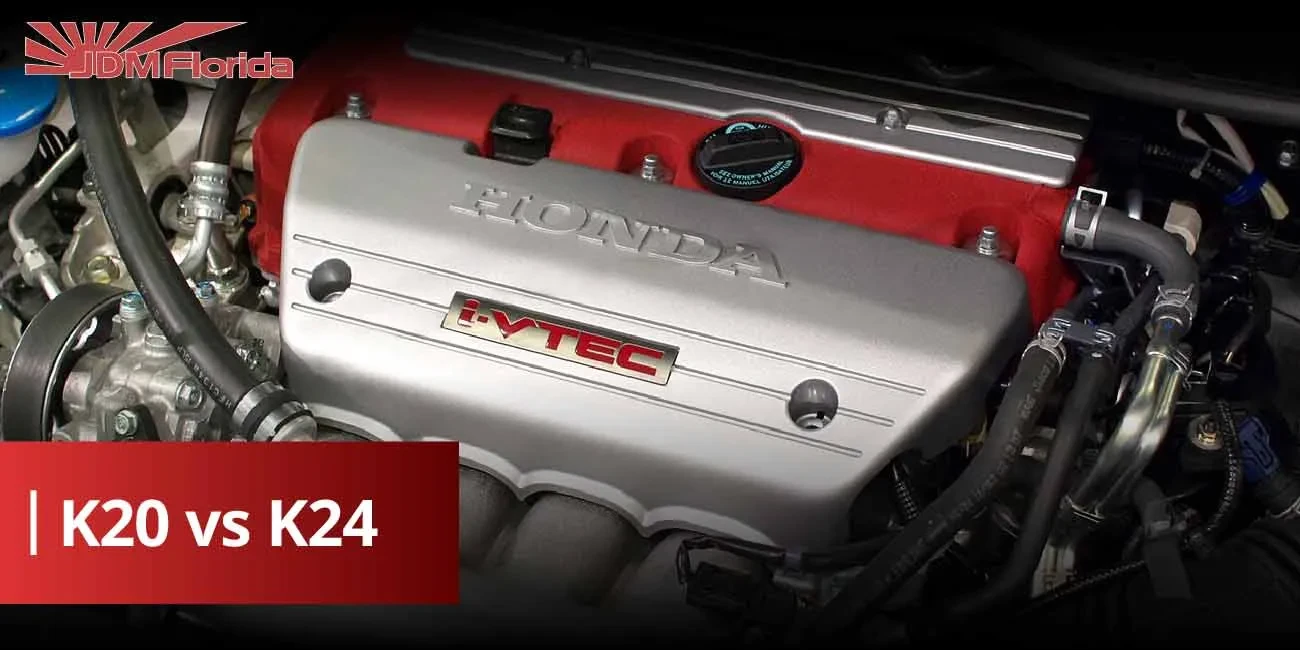
K20 vs K24 Which JDM Honda K-Series Engine Should You Buy
If you're searching for a K20 engine for sale or a K24 to drop into your chassis, you've probably hit the same wall every Honda builder hits: Which one do you actually buy? Both are part of Honda's K-series family. Both are proven. But they're built for very different goals, and picking the wrong one will cost you time and money.
This guide breaks it all down: power, torque, head variants, swap cost, and which engine fits your build.
K20 vs K24 — Quick Comparison Table
K20 — High-Revving 2.0L i-VTEC
The K20A is the performance-focused engine of the K-series family. Honda used it in the EP3 Civic Type R, the Acura RSX Type-S, and the Accord Euro R.
It runs a square bore and stroke setup at 86mm x 85.9mm. That geometry lets it rev freely without the rotational resistance you get from a long-stroke engine. The JDM K20A Type R version pushes around 220 hp at the crank and spins to 8,500 rpm.
What makes the K20A special is not just the peak number. It is how the engine gets there. VTEC engagement around 5,800 rpm turns a calm engine into something completely different. The top-end rush is what K20 owners build for.
Strengths:
High redline that keeps building past 7,000 rpm. Lightweight compared to the K24. Excellent head flow out of the box, especially with PRB or PRC heads. Strong aftermarket support for cams, intakes, and headers.
Weaknesses:
Less torque than the K24 below 4,000 rpm. Low-mileage JDM examples are harder to source. Slightly less swap-friendly in heavier platforms.
If you're building a track car or want a naturally aspirated screamer, the K20A is hard to beat. Check out our EP3 Civic buyers' guide if you're also shopping for a shell.
K24 — Torquey 2.4L Workhorse
The K24A runs a longer stroke at 87mm x 99mm. That extra stroke gives it more displacement and more torque from lower in the rev range. Honda put it in the Accord, CR-V, Element, and Acura TSX.
Stock JDM K24A figures sit around 197 hp and 171 lb-ft of torque. Peak torque hits around 4,500 rpm, which makes it feel strong and usable in real driving situations.
The K24 does not feel exciting the same way a K20 does. But it does not need to. It pulls from low rpm, it responds well to bolt-ons, and it handles boost without complaint. For a streetcar or a turbo project, that is exactly what you want.
Strengths:
More low-end torque than the K20, pulling hard from 2,500 rpm. More available in the used market, often at a lower price. Excellent base for turbo builds. Better suited for heavier chassis and daily-driven builds.
Weaknesses:
Shorter redline topping out around 7,200 rpm. Slightly heavier than the K20. The factory head does not flow as well at high rpm.
If you want a strong daily driver or a forced-induction build, the K24 engine for sale is the smarter starting point.
K-Series Head Variants Explained
This is where most buyers get lost. The head on a K-series engine changes how the engine breathes, and that changes everything about how it performs.
K20A Heads:
PRB: Found on the K20A2 (RSX Type-S). Strong flow, aggressive VTEC lobes. One of the most popular heads for a street build.
PRC: Found on the JDM K20A Type R. Better flow than the PRB, higher lift cams. Rare and sought after.
PNF / PPA: Lower-spec K20A heads. Not ideal for performance builds.
K24A Heads:
RBB: Found on the K24A (JDM Accord, Odyssey Absolute). Three-lobe i-VTEC. This is the head people actually want on a K24 build.
RBC: Found on some K24A variants. Similar to RBB with minor differences.
RAA: Economy-spec i-VTEC head. Single cam VTEC, less airflow. Not a good performance head.
One thing worth knowing: the K20 and K24 heads are nearly identical in overall design. The differences come down to port shape, cam profiles, and spring specs. K20 intake ports are slightly larger, which helps at high rpm. K24 intake ports are a bit smaller, which actually increases torque at lower rpm. Neither is wrong. They are just tuned for different power bands.
The holy grail setup: A K24A block with an RBB head. You get 2.4 liters of displacement, strong torque from the long stroke, and a head that flows well enough to support high rpm. This is the K24A2 RBB head hybrid that the whole K-series swap community talks about.
You can read more about this combination in Hybrid Racing's K20/K24 hybrid build guide, one of the most thorough technical resources available on the topic.
Power Output Comparison
Stock numbers:
K20A Type R (JDM): ~220 hp / 152 lb-ft. K20A2 (USDM RSX Type-S): ~200 hp / 142 lb-ft. K24A (JDM, RBB head): ~197 hp / 171 lb-ft.
Bolt-on potential:
Both engines respond well to basic bolt-ons. Expect 10 to 20 hp gains on either platform with intake, header, and exhaust.
Naturally aspirated build potential:
The K20A with a PRB or PRC head, aggressive cams, and a well-matched intake manifold can push 240 to 260 hp on a good tune. The K24A on its own tops out around 230 to 240 hp naturally aspirated because the factory head limits airflow at high rpm.
Put a K20A head on a K24A block, and the ceiling rises. That combo can make 260 to 280 hp naturally aspirated and becomes one of the best K-series setups for a track build.
Forced induction:
This is where the K24A separates itself. The longer stroke and bigger displacement handle boost very well. A stock K24 with a turbo kit can reach 400 to 500 hp on stock internals with the right tune. Built with forged rods and pistons, the K24 platform has seen over 1,000 hp.
K20 vs K24 Swap Difficulty
Both engines use the same basic mounting points, which makes K-series swaps one of the more straightforward engine swaps in the Honda world.
Engine mounts: Most swap mount kits cover both K20 and K24. The fitment differences are minor. You will need a purpose-built K-swap mount kit for non-K-chassis cars like the EG or EK Civic.
Axles: The K24 is slightly wider at the oil pan. In some builds, this requires axle modification or specific axle shafts. It is a small but real difference to plan for.
ECU: A stock ECU works fine for a basic swap. For a tuned build, most people use KPro or Hondata. Both platforms are well-supported.
Transmission: The K20A transmission works best for high-revving K20 builds. For K24 swaps, many builders use the K20Z3 transmission for its strong close-ratio gearing. The Z3 requires a different shifter setup, so budget for that.
One thing to watch on the K24A specifically is the balance shaft oil pump. The factory unit can cause oil pressure issues at high RPM. Most serious K24 builds swap in a K20A2 oil pump as a preventive fix. It is a straightforward job, but worth knowing before you start.
Swap kit cost runs $400 to $800 for the mounts, brackets, and hardware, depending on the chassis.
Cost Comparison
JDM K20A engine price range:
A JDM K20A engine for sale with low mileage typically runs $1,800 to $3,000. Type R variants with PRC heads sit at the higher end. Good mileage examples are harder to find than K24s.
JDM K24A engine price range:
A JDM K24A engine for sale runs $1,200 to $2,000. More available supply keeps prices lower. The K24A with an RBB head commands a slight premium.
Total swap cost:
Factor in mount kit ($400 to $800), axles if needed ($150 to $300), ECU tune ($500 to $800 for KPro), and ancillary parts at $200 to $400.
Total realistic swap budget:
K20A swap: $3,500 to $5,500. K24A swap: $2,700 to $4,500.
Both are reasonable depending on what you're building. For a K-series engine for sale that keeps the total project cost down, the K24A is the better value starting point.
Which Should You Buy?
Go K20A if you want a naturally aspirated build that screams to 8,500 rpm. You are tracking the car. You want the classic i-VTEC experience and do not mind paying a premium for a low-mileage unit.
Go K24A if you want strong usable torque from a daily driver. You are planning a turbo build. You want more engine for less money. The K24 is one of the best forced-induction platforms in the K-series lineup.
Want the best of both worlds? Go with a K24A2 RBB head build. A K24A block topped with an RBB or PRB head gives you 2.4 liters of displacement, low-end torque from the long-stroke bottom end, and airflow from a proper i-VTEC head. It is the sleeper build the K-series community has been running for years, and it works.
Neither engine is a bad choice. The K20A and K24A are both reliable, well-supported, and tuneable well beyond stock power levels. The difference is in what you want the car to feel like. A high-revving naturally aspirated K20A build and a boosted K24A build are very different experiences, even if the horsepower numbers end up similar. Know your goal first, then pick the engine that gets you there.
Ready to start your build? Browse our full inventory of JDM Honda engines, including K20A engines for sale and K24A engines for sale, all imported from Japan with verified mileage and compression tested before shipping.