- (407) 774-8324
- JDMFlorida@gmail.com
 Login
Login


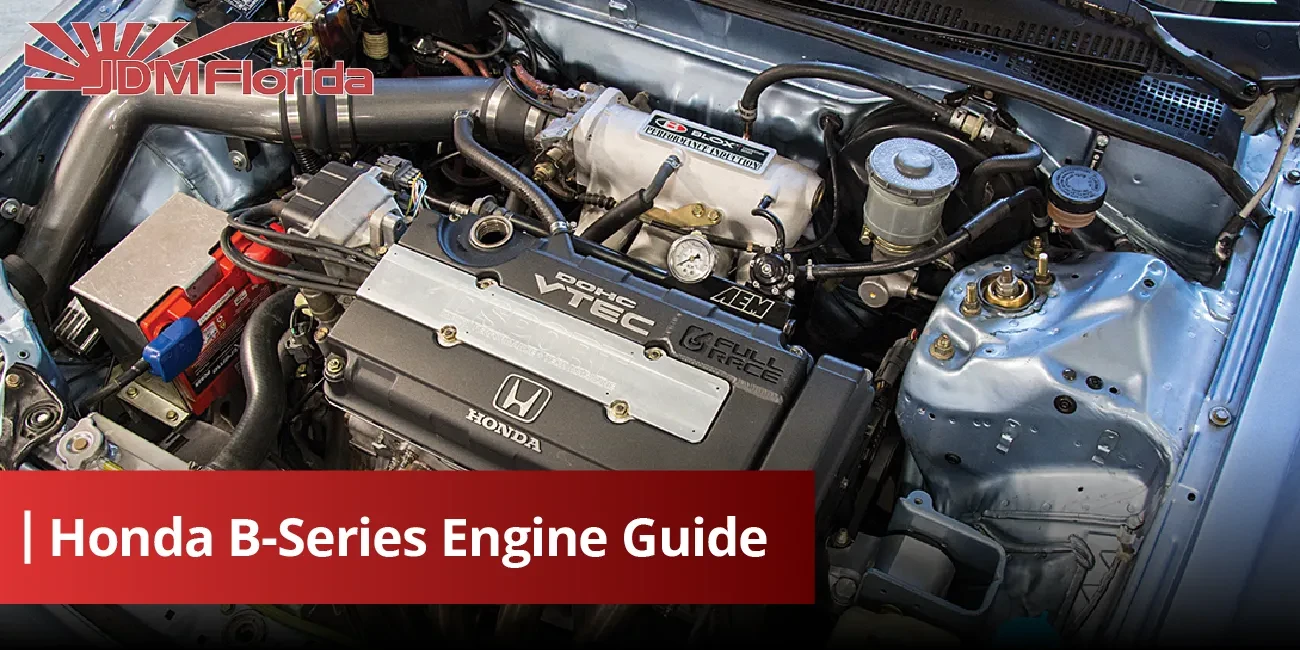
Honda B-Series Engine Guide: B16 vs B18 vs B20
If you've spent any time around Honda builds, you've heard the letter "B" get thrown around a lot. The b series engine is one of the most loved engine families Honda ever made, and for good reason. It's light, it revs like crazy, and there's a version for almost every kind of build. But B16, B18, and B20 are not the same engine wearing different badges. They're built for different jobs.
This guide breaks down what each one actually is, how they compare, and which one makes sense for your car.
What is the Honda B-series?
The Honda b series engine is a family of 1.6L to 2.0L four-cylinder engines Honda built from the late 1980s through the early 2000s. You'll find them in Civics, CRXs, Integras, Preludes and even the CR-V.
What made the b series engine special was VTEC. Honda's variable valve timing system let these small engines rev to 8,000 rpm or higher and still make real power, without needing a huge, heavy block. That's a big part of why the b series engine still has such a strong following today.
Quick facts about the family:
Displacement ranges from 1.6L (B16) to 2.0L (B20)
Most are DOHC, though some low-compression versions are SOHC
Found in Civic, CRX, Del Sol, Integra, Prelude and CR-V
Known for a redline that most modern engines can't touch
Still one of the most popular swap and build platforms in the JDM world
B-series variants explained
Each letter and number combo in the b series engine lineup tells you something. Here's a quick side-by-side before we go deeper.
B16
The b16 engine is the rev-happy heart of the family. Found in the Civic SiR, CRX SiR, and Integra XSi (depending on market), the B16A and B16A2 are 1.6L DOHC VTEC engines that love to spin. The b16 a2 engine version, sold in some US Civics, is a slightly detuned edition for emissions, but it still keeps that same high-revving character.
The B16B, only ever put in the JDM Civic Type R (EK9), is the flagship. It made close to 185 PS from just 1.6 liters, which was an insane number for a naturally aspirated four-cylinder at the time. Honda still hasn't beaten that power-per-liter figure with a naturally aspirated B or K engine.
If your goal is a screaming, high-rpm Honda that feels alive at 7,000 rpm, the b16 engine is the answer.
B18 / B18C1
The b18 engine steps things up in displacement without losing the VTEC magic. The non-VTEC versions (B18A1, B18B1) were built for everyday Integras and focused on smooth, low-end torque rather than top-end drama.
The b18c engine is where things get interesting. The B18C1, used in the USDM Integra GS-R, gave drivers a genuine mix of torque and top-end rush. It's often seen as the sweet spot: enough low-end grunt to be usable daily, enough VTEC kick to have fun on a back road.
Then there's the B18C in Type R spec, sometimes labeled B18C5 or B18C-R depending on the market. This is the b18c hp king of the naturally aspirated B-series world, with higher compression, better internals, and a proper Type R tune pushing around 195-200 PS. If you want the "best of the best" NA B18, this is it.
B20
The b20 engine started life with a very different mission. Honda built the B20B and B20Z as SOHC, non-VTEC engines for the CR-V. They were never meant to be exciting. They were meant to be reliable and torquey.
So how did the honda b20 engine become a build legend? Enthusiasts realized the B20 block has more displacement than any other B-series casting, and it happily accepts a VTEC head from a B16 or B18C. Swap that head on, and you get the b20 vtec engine, sometimes called the "B20/VTEC" or "Frankenstein" build. You end up with more low-end torque than a B16 or B18, plus the VTEC kick on top. It's one of the most popular budget big-power builds in the whole Honda scene.
If you're chasing a b20 engine spec sheet for a hybrid build, know that the block itself is the star, not the factory head.
B16 vs B18 vs B20: which should you choose?
There's no single "best" answer here. It depends on what kind of driving experience you want.
Best for revs
If you want a Honda engine that feels like it's on a mission every time you hit VTEC, the b16 engine wins. It's light, it revs to the moon, and it rewards a driver who likes to keep the RPMs up. Great for autocross, track days, or anyone who just loves the sound of a Honda screaming past 7,500 rpm.
Best for torque
For a more relaxed, daily-friendly feel, the b18 engine (especially the non-VTEC or B18C1 versions) gives you more usable low and mid-range power. Less drama, more everyday drivability. If you want a build that doesn't need constant high-rpm driving to feel quick, B18 is the safer bet.
Best for big-power builds (B20 VTEC)
If your goal is a serious, high-horsepower build (naturally aspirated or turbo) on a budget, the honda b20 engine with a VTEC head swap is hard to beat. More displacement means more torque everywhere, and the larger block generally handles boost better than a stock B16 or B18 short block. This is the go-to for a lot of best b series engine builds when the goal is raw power, not just factory nostalgia.
B-series vs K-series: which is the better swap?
This debate never really ends. The K-series (K20/K24) came after the B-series and brought i-VTEC, roller rockers, an all-aluminum block, and more low-end torque out of the box, especially with the K24. It's generally seen as the more modern, more swap-friendly option today, with a bigger aftermarket and more forgiving stock internals.
The b series engine still has its own case though: it's lighter, simpler to wire up in older chassis like the EG Civic or DC2 Integra, and has decades of proven tuning knowledge behind it. For a lot of old-school builds, running a B-series just feels more "right" than dropping in a K-series.
We've gone deep on this exact comparison in our K20 vs K24 guide, which is worth reading if you're trying to decide between a B-series and K-series swap for your project.
B-series reliability and what to check when buying
The good news is B-series engines are generally tough. The bad news is that decades of hard driving, track use, and questionable maintenance history mean quality varies a lot from engine to engine. Here's what to actually check:
Compression numbers. A healthy B-series should show even compression across all four cylinders. Big gaps point to worn rings or a tired head.
VTEC solenoid and oil pressure. A rough VTEC engagement or a slow-to-kick-in VTEC often means a clogged solenoid or low oil pressure, not always a bad engine.
Timing belt history. These are interference engines. If you don't know when the belt was last done, budget for a new one right away.
Distributor condition. B-series engines use a distributor, not coil packs. Check for cracks, worn caps, and rotor wear.
Rod bearings on high-mileage or boosted engines. If the seller mentions boost history, ask about bottom-end work. Stock B-series internals can take mild boost, but not forever.
Documentation. Mileage records and import paperwork matter a lot when it comes to imported JDM units. A clean paper trail is worth paying extra for.
Where to buy an imported Honda B-series engine
If you're set on getting a genuine JDM b series engine rather than a tired domestic-market unit with unknown history, buying imported is usually the smarter move. Low-mileage JDM engines typically come from cars that were pulled off the road early due to Japan's strict vehicle inspection system, not because they were worn out.
When you're shopping, look for sellers who provide compression test results, mileage documentation, and clear photos of the actual engine you're buying, not stock catalog photos. At JDM Florida, we bring in low-mileage B16, B18 and B20 engines straight from Japan and check them before they ever reach a customer, so you're not gambling on a mystery motor.
Honda B-series FAQ
Which B-series has the most power?
In stock form, the B18C Type R (also referred to in some markets under the B18C5 code) and the B16B both stand out, with the B18C Type R generally putting out the most raw horsepower in factory form. Once you get into built engines, though, the honda b20 engine with a VTEC head and forged internals can outmuscle both of them, especially in turbo builds.
Is the B18C the Type R engine?
Sort of, and this confuses a lot of people. The B18C1 is the engine in the USDM Integra GS-R, which is not a Type R. The Type R version, often labeled B18C (or B18C5/B18C-R depending on the market), has higher compression, better internals, and a different tune, making it the true Type R engine. So B18C1 and B18C Type R share a name family but are not the same build.